Grigori Fursin created cTuning.org in 2008, established the non-profit cTuning foundation in 2014 and developed Collective Knowledge technology to support his quest to enable open science and help everyone participate in collaborative research and solve the real-world problems by facilitating reproducible experiments and bridging the growing gap between AI/ML research and production.
In 2022, we donated our Collective Knowledge v2 to MLCommons and established a public MLCommons task force on automation and reproducibility to continue developing it with the community in an open and transparent way to benefit everyone.
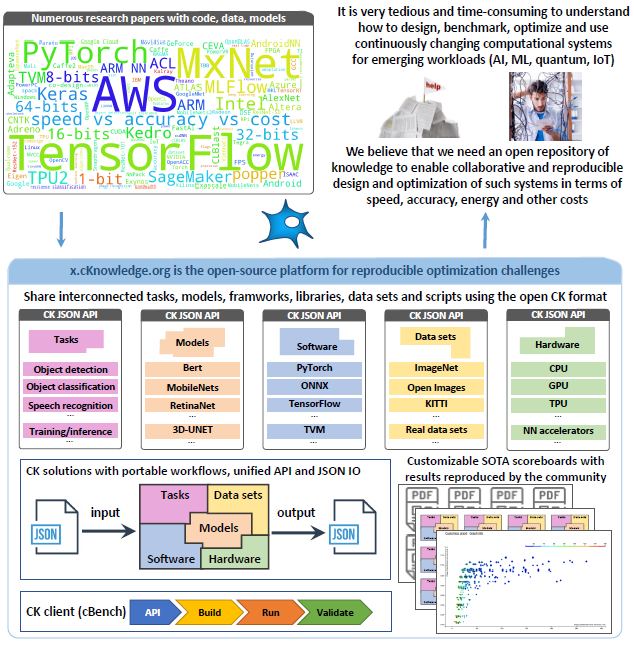
We are now leading the development of a new, open-source, technology-agnostic and portable Collective Mind automation and reproducibility language (CM) to empower everyone from a company expert to a child to automatically reproduce, optimize, integrate and deploy the state-of-the-art AI/ML solutions in the real-world in the fastest and most efficient way while slashing research, development, optimization and operational costs.
CM automation language is adopted and extended by the community via Discord to collaboratively benchmark and optimize AI and ML systems across diverse software, hardware, models and data from different vendors and share all the knowledge and experience via CK playground.
Our open-source technology already helped the community and many companies automate and optimize their MLPerf benchmark submissions while contributing to more than half of all MLPerf inference performance and power results since the beginning.
We also support artifact evaluation and reproducibility challenges at the leading ML and Systems conferences to improve reproducibility, replicability and reusability of research projects in the rapidly evolving world.
We are collaborating with MLCommons to develop a Collective Knowledge v3 Platform (CK playground) - an open-source platform to empower everyone automatically explore, select, co-design, optimize and deploy the most efficient AI solution based on their requirements and constraints (accuracy, performance, power consumption, size and price) while slashing all development costs and time to market.
The CM automation language and CK playground that we are developing in collaboration with MLCommons are now used to automate reproducibility and optimization challenges for AI/ML systems, MedPerf platform, automotive benchmarking consortium, MLPerf benchmarks, LLM-based assistants and other projects across rapidly evolving software, hardware, models and data.
We are honored that our expertise and open-source technology has helped the following initiatives:
- helped ACM develop a common methodology to reproduce research papers and set up Emerging Interest Group on Reproducibility and Replicbility;
- helped ACM and IEEE conferences organize 20+ reproducibility challanges and artifact evaluations;
- helped MLCommons establish the MLCommons Task Force on Automation and Reproducibility to run MLPerf benchmarks out of the box on any software and hardware from the cloud to the edge using the portable and technology-agnostic Collective Knowledge v3 that we are developing with the community and MLCommons;
- helped students, researchers and practitioners learn the best practices for collaborative and reproducible research: ACM Tech Talk'21 and keynote at ACM REP'23.
Our current community activities include:
- leading the MLCommons task force on automation and reproducibility to automate and simplify the development of Pareto-efficient AI/ML applications and Systems with the help of the Collective Knowledge platform powered by the open-source and technology agnostic automation language;
- organizing optimization and reproducibility challenges with MLCommons to develop more efficient AI/ML applications and systems in terms of speed, accuracy, power consumption, size and costs;
- setting up Artifact Evaluation at AI, ML and Systems conferences to reproduce results from research papers and validate them in the real world across continuously changing models, data, software and hardware;
- unifying the Artifact Appendix and reproducibility checklist across different AI, ML and Systems conferences.
- 2023 December: We've completed the artifact evaluation for ACM/IEEE MICRO'23 and prototyped the use of the common MLCommons CM automation interface to make it easier for the community to run and reproduce experiments from published papers. See our report for more details.
- 2023 September 15:
The cTuning foundation is proud to help MLCommons develop the new version of the Collective Knowledge Technology v3
with the open-source MLCommons CM automation language,
CK playground
and modular inference library (MIL)
that became the 1st workflow automation enabling mass submission of more than 12000 performance
results in a single MLPerf inference submission round with more than 1900 power results across more
than 120 different system configurations from different vendors
(different implementations, all reference models and support for DeepSparse Zoo,
Hugging Face Hub
and BERT pruners from the NeurIPS paper, main frameworks and diverse software/hardware stacks)
in both open and closed divisions!
This remarkable achievement became possible thanks to open and transparent development of this technology as an official MLCommons project with public Discord discussions, important feedback from Neural Magic, TTA, One Stop Systems, Nutanix, Collabora, Deelvin, AMD and NVIDIA, and contributions from students, researchers and even school children from all over the world via our public MLPerf challenges. Special thanks to cKnowledge for sponsoring our developments and submissions, to One Stop Systems for showcasing the 1st MLPerf results on Rigel Edge Supercomputer, and to TTA for sharing their platforms with us to add CM automation for DLRMv2 available to everyone.
Since it’s impossible to describe all the compelling performance an power-efficient results achieved by our collaborators in a short press-release, we make them available with various derived metrics at the Collective Knowledge playground, mlcommons@cm4mlperf-results and this news page. We continue enhancing the MLCommons CM/CK technology to help everyone automatically co-design the most efficient end-to-end AI solutions based on their requirements and constraints. We welcome all submitters to follow our CK/CM automation developments at GitHub and join our public Discord server if you want to automate your future MLPerf submissions at scale.
See related HPC Wire article about cTuning and our CM/CK technology, and contact Grigori Fursin for more details!
- 2023 July 19: We are very excited to be a part of the great collaborative project to enable "Federated benchmarking of medical artificial intelligence with MedPerf" - see the overview of this collaborative platform in the Nature article.
- 2023 June 28: We are honored to give a keynote at the 1st ACM conference on reproducibility and replicability. You can find our slides at Zenodo.
- 2023 June 14: We are preparing Artifact Evaluation at ACM/IEEE MICRO 2023 - stay tuned for more details! Since criteria for the ACM "Artifacts Evaluated - Reusable" badge are quite vague, we partnered with the MLCommons task force on automation and reproducibility to add their unified interface (MLCommons CM) to the submitted artifacts to make them more portable, reproducible and reusable. This interface was successfully validated at the Student Cluster Competition at SuperComputing'23 and we would like to test it as a possible criteria to obtain the ACM "Artifacts Evaluated - Reusable" badge Our ultimate goal is to provide a common interface to evaluate and reuse all artifacts across diverse and rapidly evolving software and hardware. We suggest the authors to join the public Discord server for this task force to get free help from the community and MLCommons to add this interface to their artifacts before evaluation. The authors can also try to add this unified interface themselves following this tutorial.
- 2023 May 17: The cTuning foundation joined forces with AVCC and MLCommons to help develop industry's first Automotive Benchmark based on our automation language and reproducibility methodology.
- 2023 April: We have successfully validated this artifact evaluation methodology combined with the MLCommons CM automation language to automate ~80% of MLPerf inference v3.0 submissions (98% of all power results): LinkedIn, Forbes, ZDNet.
- 2023 April 5: We are excited to see our open-source Collective Knowledge playground highlighted in the Forbes article.
- 2023 April 5: The cTuning foundation joins forces with MLCommons to develop Collective Knowledge Playground for collaborative optimization challenges: press-release.
- 2023 April 3: Public release of our free, open-source and technology-agnostic MLCommons Collective Knowledge Playground (CK) to automate benchmarking, optimization and reproducibility of MLPerf inference benchmark via collaborative challenges!
- 2023 Feb 16: New alpha CK2 GUI to visualize all MLPerf results is available here.
- 2023 Jan 30: New alpha CK2 GUI to run MLPerf inference is available here.
- 2022 November: We are very excited to see that our new CK2 automation meta-framework (CM) was successfully used at the Student Cluster Competition'22 to make it easier to prepare and run the MLPerf inference benchmark just under 1 hour. If you have 20 minutes, please check this tutorial to reproduce results yourself ;) !
- 2022 September: We have helped MLCommons to prepare and release CM v1.0.1 - the next generation of the MLCommons Collective Knowledge framework being developed by the public workgroup. We are very glad to see that more than 80% of all performance results and more than 95% of all power results were automated by the MLCommons CK v2.6.1 in the latest MLPerf inference round thanks to submissions from Qualcomm, Krai, Dell, HPE and Lenovo!
- 2022 July: We have pre-released CK2(CM) portable automation scripts for MLOps and DevOps: github.com/mlcommons/ck/tree/master/cm-mlops/script.
- 2022 March: We've started developing the CM framework (aka CK2) based on the community feedback - join our collaborative effort!
- 2022 February: We've helped with artifact evaluation at ASPLOS'22!
- 2021 September: We are excited to announce that we have donated our Collective Knowldege technology and the MLPerf inference automation suite v2.5.8 to MLCommons (github.com/mlcommons/ck and github.com/mlcommons/ck-mlops) to benefit everyone! .
- 2021 March: Our ACM TechTalk about "reproducing 150 Research Papers and Testing Them in the Real World" is available on the ACM YouTube channel.
- 2021 March: The report from the "Workflows Community Summit: Bringing the Scientific Workflows Community Together" is available in ArXiv.
- 2021 March: Our paper about the CK technology has appeared in the Philosophical Transactions A, the world's longest-running journal where Newton published: DOI, ArXiv.
- 2020.December: We are honored to join MLCommons as a founding member to accelerate machine learning innovation.
- 2020.November: We are very excited to announce that we have completed the prototyping phase of our Collective Knowledge framework (CK) and successfully validated it in multiple industrial and academic projects as described in this white paper and the FASTPath'20 presentation. We have helped our partners and the community to use CK as an extensible playground to implement reusable components with automation actions for AI, ML, and systems R&D. We used such components to assemble portable workflows from reproduced research papers during our reproducibility initiatives at ML and systems conferences. We then demonstrated that it was possible to use such portable workflows to automate the co-design process of efficient software, hardware and models, simplify MLPerf inference benchmark submissions, and quickly deploy emerging AI, ML, and IoT technology in production in the most efficient way (speed, accuracy, energy, costs) across diverse platforms from data centers to edge devices.
Sponsors